
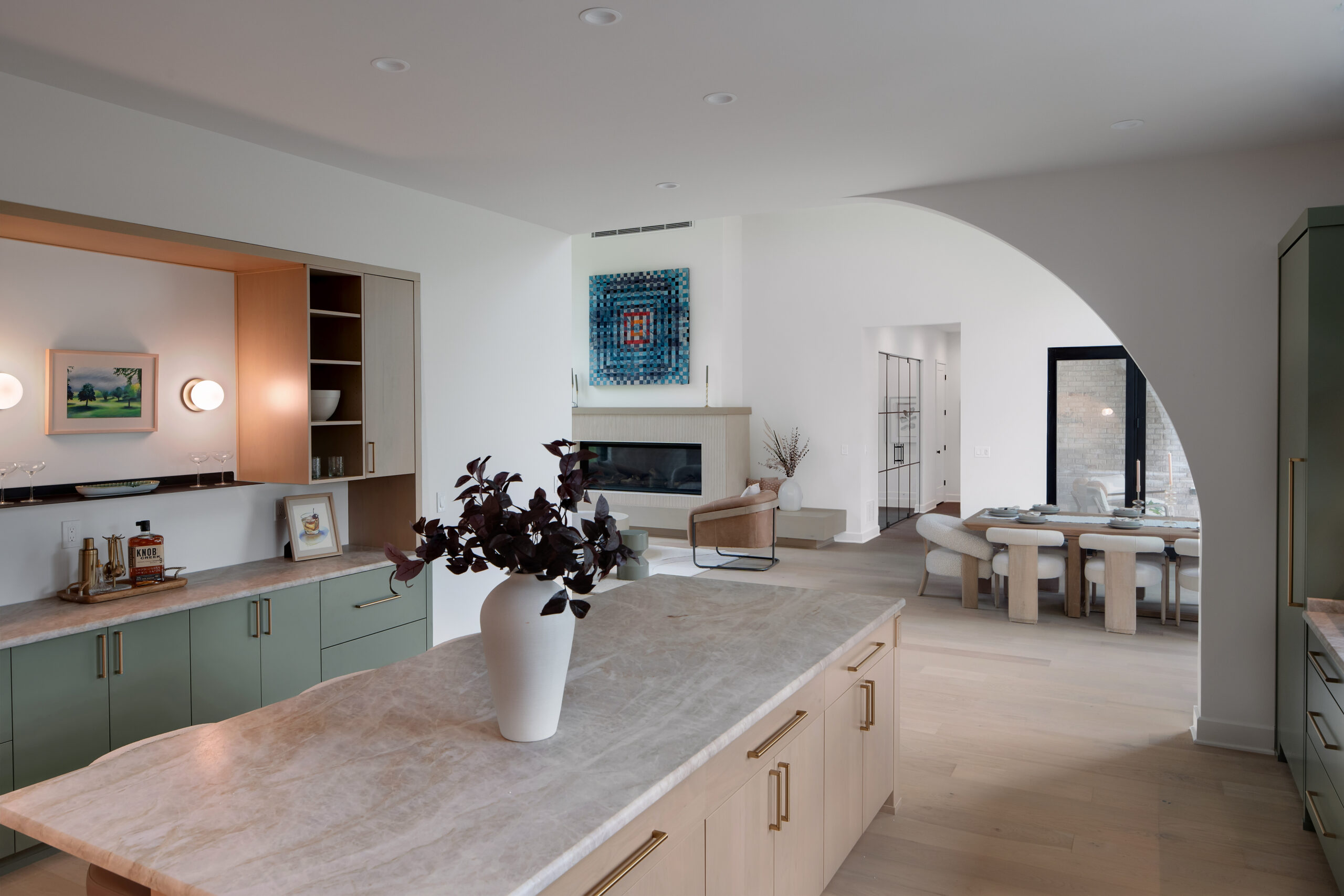
Building a custom home is never just about selecting finishes or choosing a floor plan. It is about finding a place where that home will continue to hold value, character, and purpose for decades to come. Some neighborhoods are designed purely around convenience: a grid of similar lots, a handful of repeated elevations, streets built to move cars rather than gather neighbors. Others are designed around something deeper: connection, architecture, and the kind of lasting quality that only comes from genuine intention.
Clore Station is one of those rare communities, planned from the ground up rather than assembled from a template. For Eldridge Company, that distinction matters. Custom homebuilding, done well, is about designing homes that respond to the character of exceptional communities, and Clore Station gives us exactly the kind of canvas a custom builder dreams about.
Picture a Tuesday evening. You step outside, and within a few minutes you are walking a tree-lined street toward a small gathering of neighbors on a front porch, or toward a future town center where dinner, coffee, or a quiet bench along a trail is waiting. That is the experience Clore Station is designed around, not an amenity list, but a rhythm of daily life.
Walkable streets encourage exactly this kind of connection. The nonprofit Project for Public Spaces, a longtime authority on community design, describes placemaking as the practice of shaping public space around people rather than around infrastructure, creating a strong sense of place that shapes the physical, social, and emotional health of a community. That is a fitting description of what a traditional, walkable layout offers: a reason to be outside, a reason to know your neighbors, a reason for a neighborhood to feel like an actual place rather than a collection of driveways.
Layered through those streets are parks, trails, and preserved green space, the kind of natural buffer that makes a dense, walkable community feel spacious rather than crowded. Research from the Trust for Public Land shows that proximity to well-maintained green space consistently raises the value of nearby homes, with buyers willing to pay a premium of 5 to 15 percent for homes near a quality park. Future restaurants, retail, and gathering spaces will sit within easy walking distance, so errands become part of the stroll rather than a separate trip in the car.
This is thoughtful planning in the truest sense. It creates a genuine sense of place instead of another subdivision, and it is exactly the kind of setting where a home is designed to be lived in, not just parked in front of.
A community this intentional deserves a home that is just as intentional, which is where the conversation shifts from planning to architecture.
There is a real difference between a custom home and a production home. According to the National Association of Home Builders, production builders typically restrict design to a group of preselected styles across a large number of homes each year, while a custom home builder starts fresh with each project, often building fewer than ten homes annually so that every design can be shaped around the individual client and the individual lot. That distinction is not a marketing point. It is the entire philosophy behind how Eldridge Company approaches a homesite.
Rather than forcing one floor plan onto every lot in a community, we design around the lot itself, its slope, its sun exposure, its relationship to the street and to the green space beyond it. This kind of lot-specific design is what separates a house from a home. A home at Clore Station might be shaped to capture natural light through a great room window at the right hour of the afternoon, or oriented so a covered porch looks out over a quiet stretch of trail instead of a neighbor’s driveway. Rolling topography becomes a design opportunity rather than an obstacle. The goal is timeless architecture that feels right the day it is finished and complements the overall vision of the neighborhood around it, rather than architecture that simply fills a lot.
There is no need to rush this decision, but there is real value in planning ahead. Building during the early phases of a community like Clore Station simply creates more possibilities.
Early phases offer a wider range of lot options, whether that means a homesite backing up to a greenway, one with a favorable orientation for natural light, or one positioned close to the future town center. Early involvement also means greater design flexibility. Working with Eldridge Company from the earliest stages gives homeowners more room to personalize layouts, exterior details, and finishes, rather than selecting from whatever inventory happens to remain later in a phase. It is the difference between building exactly for your family’s lifestyle and settling for what is left. This is not urgency for its own sake. It is simply the natural advantage of planning ahead.
Choosing where to build is, in its own way, an investment, though not purely a financial one. Architectural consistency protects the long-term appeal of a neighborhood, since a shared design language keeps a community from feeling disjointed as it matures. That consistency is a quiet but powerful driver of long-term home value. Green space and community amenities enhance everyday living long after the initial excitement of moving in has settled into routine, and the EPA’s research on walkable neighborhood design confirms that the built environment itself, not just individual home features, plays a measurable role in how a community functions and endures. Thoughtful community planning is the foundation everything else is built on.
Quality construction paired with quality planning is what creates that lasting value. A beautifully built home in a poorly planned neighborhood will always be fighting its surroundings. A beautifully planned neighborhood deserves homes built with the same level of care. Choosing the right builder matters just as much as choosing the right neighborhood, because one is meant to honor the other.
A custom home should reflect not only your family, but the community around it. Clore Station offers a rare opportunity to build in a neighborhood designed with longevity, connection, and quality craftsmanship in mind, and Eldridge Company is committed to creating homes that honor that vision at every stage of the design process.
Ready to start planning your future home? Contact the Eldridge Company team to learn about available homesites at Clore Station, explore custom floor plans, and begin designing a home that fits both your lifestyle and the vision of this community. Reach out to Eldridge Company today to start the conversation.
Eldridge Company LLC, 509 Barret Avenue, Louisville, KY, 40204, United States 502-625-5565 info@eldridgecompany.com